MORE =
https://www.artsy.net
https://japingkaaboriginalart.com
https://aaia.com.au
https://australianmalleeart.com.au
https://gallery.sunshinecoast.qld.gov.au
https://www.artlink.com.au
https://thisisaboriginalart.com.au
| Walala Tjapaltjarri | |
|---|---|
| Born | Walala Tjapangati early 1970s[2] Marruwa, Western Australia |
| Occupation | Painter |
| Years active | late 1980s – present |
| Organization | Papunya Tula |
| Style | Western Desert art |
| Spouse | Brigitte Napangardi |
| Children | Clarissa (born 1991) Josiah (born 1996) |
| Parents | Lanti, or “Joshua” (father) Watjunka Nangala (mother) |
| Relatives | Thomas Tjapangati Yalti Napangati Yukultji Napangati Warlimpirrnga Tjapaltjarri Topsy Napaltjarri Takariya Napaltjarri |
Walala Tjapaltjarri (born Walala Tjapangati) is an Australian Aboriginal artist.
Early life
See also: Pintupi Nine
Tjapaltjarri was born in the late 1960s or early 1970s. He was born at Marua, near Lake Mackay. He grew up living a nomadic, traditional way of life in the desert. His family had never come into contact with modern, Euro-Australian society. He had never seen a white person, and his family always thought the aeroplanes they saw flying overhead were ghosts or spirits.[3] Before Tjapaltjarri was born, his father Lanti had lived for a short time at the mission in Balgo. But he had run away after getting into trouble for stealing food. It was his decision to stay in the desert, and kept his family far away from the towns.[4] Tjapaltjarri’s mother was named Watjunka, and he was Watjunka’s only child. He also had two other mothers, Papunya and Nanu, who were his father’s secondary wives (and his mother’s sisters). His father and Watjunka both died when he was young. The family finally came into contact with outsiders in October 1984, and were settled at Kiwirrkurra. He and his family became known as the last Aborigines living a traditional nomadic way of life in Australia.[4]
He is now married with two children,[4] and lives between Kiwirrkura, Alice Springs, and Yuendumu, where his wife is from.[3][5] He paints at Hoppy’s Camp, outside Alice Springs.[6]
Painting
Tjapaltjarri began painting in December 1987, a few years after settling at Kiwirrkurra.[1] He was introduced to painting by his cousin Warlimpirrnga.[5] He taught Tjapaltjarri about using paints and canvas. Tjapaltjarri joined the Papunya Tula artists, and he, Thomas, and Warlimpirrnga eventually gained fame internationally as the Tjapaltjarri Brothers.[1] Although he normally paints using Tjapaltjarri as a surname, Tjapaltjarri’s skin name is Tjapangati. He now works on paper with a mixture of paint and traditional pigments.
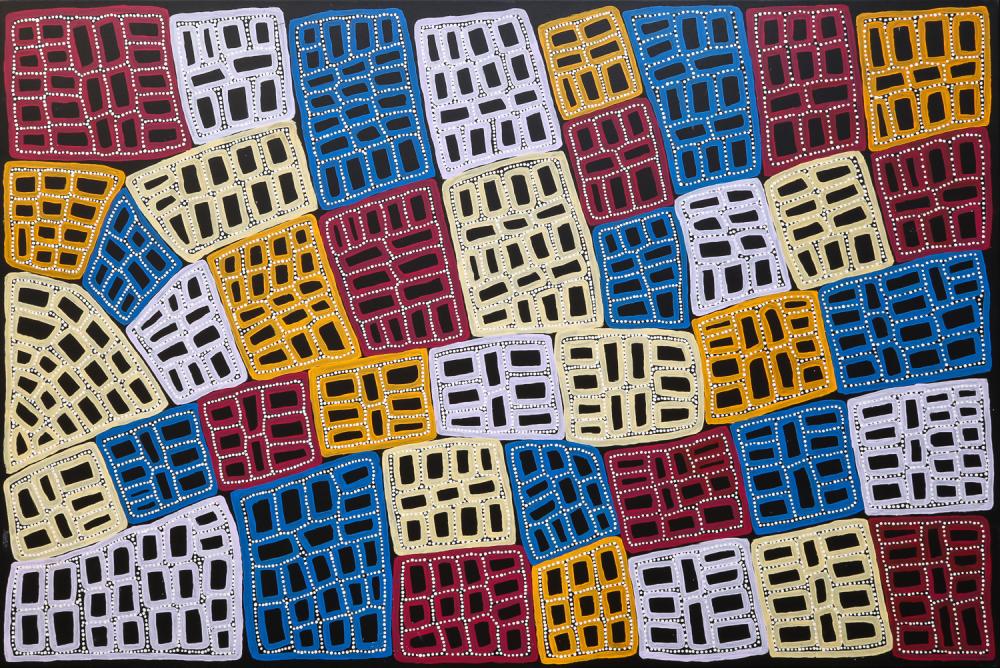
His paintings depict scenes from the Tingari cycle (sacred and secret songs about the ancestors of the Pintupi).[7] He uses only four colours at most, sticking to earthy, ochre colours to reflect the desert landscape. The places he depicts in his paintings are part of his traditional country,[5] including Marruwa, Mintarnpi, Wanapatangu, Mina Mina, Naami, Yarrawangu and Wilkinkarra (Lake Mackay). These were places where the ancestors stopped for ceremonies when travelling across the country.[3]
Tjapaltjarri uses acrylic paintings on canvas. His early work was in the flowing “dot” style of painting typical of the Papunya Tula artists. His style became different during the late 1990s, and began to paint rigid rectangles, replacing dotted lines with thick, solid lines.[3]
His first exhibition was in 1997, for the National Aboriginal and Torres Strait Islander Art Award in Darwin. Most of his work is shown in exhibitions alongside the works of other Aboriginal artists. He has paintings in permanent collections in Australia, Europe and the United States. Tjapaltjarri paints the most out of the three Tjapaltjarri brothers. When painting regularly, he earns up to AU$2000 a day.[6] His paintings often sell for many thousands of dollars.[8]
References
- Johnson, Vivien (2008). Lives of the Papunya Tula Artists. Alice Springs: IAD Press. pp. 250, 252.
- The exact date is not known, and different sources make very different guesses. Some of the years given by sources are 1969, 1972 and 1973.[1]
- “Walala Tjapaltjarri”. Red Desert Gallery. Archived from the original on 17 March 2012. Retrieved 28 July 2012.
- Toohey, Paul (4 May 2004). “The Last Nomads” (PDF). The Bulletin. pp. 28–35. Archived from the original (PDF) on 4 March 2016. Retrieved 11 February 2016.
- “Biography – Walala Tjapaltjarri”. Aboriginal Art Online. Aboriginal Art Online Pty Ltd. Retrieved 28 July 2012.
- Adlam, Nigel (3 February 2007). “Lost tribe happy in modern world”. Herald Sun. Herald & Weekly Times Pty Ltd.
- Bett Gallery (27 May 2008). “Auckland exhibition of leading Aboriginal Art”. Scoop News. Scoop Media. Retrieved 28 July 2012.
- Adlam, Nigel (23 June 2009). “Swine flu fears sweep through communities”. Northern Territory News. Darwin: News Limited.
Walala Tjapaltjarri’s original acrylic paintings typically range from $1,500 AUD to $9,500 AUD, depending heavily on the canvas size, complexity, and gallery. Smaller or medium works (around 90×60 cm) usually price between $1,600 AUD and $2,500 AUD, while larger major works climb past $5,000 AUD to $9,500 AUD. At auction, secondary market pieces can sometimes be acquired from $1,000 AUD to $3,500 AUD. [1, 2, 3, 4, 5, 6]
Key Price Factors
Size & Medium: Large-scale acrylic on linen or canvas command the highest gallery retail values.
Provenance: Works come with a Certificate of Authenticity and recognition from his status as one of the renowned Pintupi “Lost Tribe” artists. [1, 2, 3, 4, 5, 6]
Where to Buy: Specialized Indigenous galleries like Artlandish Aboriginal Art Gallery, Mitchell Fine Art, or secondary auction houses set current market benchmarks. [1, 2, 3, 4]
If you are looking to buy or sell a piece, let me know:
SHORT Biography
Walala Tjapaltajarri was born in the Gibson Desert east of Kiwirrkura in the early 1960s. In October, 1984, he was one of a small party of nine people from the Pintupi language group who walked out of the Gibson Desert into the small, remote Kiwirrkura community in northern Western Australia. Their arrival generated enormous interest and international headlines. Until this point Walala had never encountered Europeans or their ways. The group had been following their traditional lifestyle in the desert country west of Lake Mackay.
It was Walala’s brother, Warlimpirrnga, who instructed him in the use of paints and canvas. Walala started painting classic Tingari images. While Walala’s first paintings used a classical Tingari iconography usually reserved for body painting, ground painting and the decoration of traditional artefacts.
By 1996 his painting style had evolved into the works he continues to paint, characterised by rectangular shapes with surrounding dots and a limited palette of up to four colours. Walala Tjapaltajarri paints the Tingari Cycle, a series of sacred and secret mythological song cycles, which is associated with the artist’s many Dreamings.
Japingka Gallery has exhibited the work of Walala Tjapaltjarri over many years including the exhibitions –
2013 Landmarks and Law Grounds: Men of the Desert
2011 Tjapaltjarri Brothers
2004 Travels of the Tingari – New Pintupi Works
2003 Pintupi – Major Works from the Western Desert
2000 Sand, Spinifex and Salt
1998 Tingari, My Dreaming – Three Leading Pintupi Artists
A selection of paintings by Walala Tjapaltjarri is available from Japingka Gallery, where collectors can buy Aboriginal art online with certainty of quality, authenticity and provenance of art works.
Notable Sold Lots

Sold
Oct. 11, 2022
Walala Tjapaltjarri – Tingari Cycle, 2002
Est: $6,000 – $9,000
Sold:$5,500
Walala Tjapaltjarri, brother of well-known painters Warlimpirrnga and Thomas Tjapaltjarri, was born in the Gibson Desert east of Kiwirrkurra in the early 1960s. In 1990, Walala watched in admiration and respect as his brother Warlimpirrnga began to paint. Shortly thereafter, he took to painting with the assuredness of a young man firmly grounded in his culture and intimately familiar with the sites he depicted. His subject from the outset was that of the Tingari cycle associated with a number of related sites in his country including Marua, Minatarnpi, and Mina Mina in the Gibson Desert of Western Australia. Having developed his style during the early 1990s, Walala produced a work on canvas in 1997 that was unlike anything he had done before. Strongly gestural and boldly graphic, it featured roundels, rectangles,and abutting lines set against a stark monochrome black background. This distinctive and individual style laid the foundation for the remarkable body of work that he has completed since that time. His first solo shows were held with Gallery Gondwana in Alice Springs, which was the gallery that encouraged and first presented his art. Following his 1998 solo exhibition at Coo-ee Aboriginal Art Gallery in Sydney, SMH art critic John McDonald enthusiastically endorsed his work. The Tingari Cycle is a secret song cycle sacred to initiated men. The Tingari are Dreamtime Beings who travelled across the landscape performing ceremonies to create and shape the country associated with Dreaming sites.Cooee Art

Sold
Nov. 18, 2025
WALALA TJAPALTJARRI, born 1970, Tingari, 2004, steel and bronze patina, 50h x 33.5w x 18d cm, inscribed on base: FW8568, PROVENANCE, Fireworks Gallery, Qld Cat No. FW8568, Private collection, Germany, thence by descen…
Est: $3,000 – $4,000
Sold:$5,000
WALALA TJAPALTJARRI born 1970 Tingari, 2004 steel and bronze patina 50h x 33.5w x 18d cm inscribed on base: FW8568 PROVENANCE Fireworks Gallery, Qld Cat No. FW8568 Private collection, Germany thence by descent Private collection, NSW accompanied by a certificate of authenticity from Fireworks Gallery EXHIBITED New Sculpture, Maunsell Wickes Gallery, Paddington, NSW, November 2004 Repetition, Fireworks Gallery, Brisbane, Qld, 26 February – 24 March 2005 Smoke, Despard Gallery, Hobart, TAS, June – July 2005 Two Way: Artists and Mentors, Fireworks Gallery, Brisbane, Qld, 8 March – 8 April 2006 This steel sculpture by Walala Tjapaltjarri represents the Tingari Cycle, an important group of Dreaming stories passed down by the Pintupi people of the Western Desert. These stories tell of the Tingari men, ancestral beings who travelled across vast stretches of desert, shaping the land and creating sacred sites. Walala is known for his bold, geometric style, which he uses to map out Country and ceremony. In this work, he translates his signature visual language, normally seen in acrylic dot paintings, into the hard, lasting surface of steel. Concentric squares, straight lines, and pathways echo the Tingari journeys, bringing a powerful cultural narrative into a contemporary sculptural form. Though made from industrial material, the sculpture remains deeply connected to the desert landscape and the ancient knowledge held within it. @ WALALA TJAPALTJARRI / Copyright Agency, 2025Art Leven (formerly Cooee Art)

Sold
Dec. 07, 2017
Walala Tjapaltjarri (c. 1960 – ) Sans titre
Est: €6,000 – €6,500
Sold:€4,500Millon Riviera

Sold
Sep. 22, 2020
THOMAS, WALALA, WARLIMPIRRNGA TJAPALTJARRI (born c.1964, 1960, c.1958) Tingari Dreaming synthetic polymer paint on canvas
Est: $5,000 – $7,000
Sold:$4,400
THOMAS, WALALA, WARLIMPIRRNGA TJAPALTJARRI (born c.1964, 1960, c.1958) Tingari Dreaming synthetic polymer paint on canvas 160.5 x 381cm PROVENANCE: Justin Turner Art Index, Sydney Private collection, SydneyLeonard Joel

Sold
Jul. 27, 2026
WALALA TJAPALTJARRI, Australia (Aboriginal) (1962 – 2026), Tingari, acrylic on canvas (ready to hang), 161 x 102 x 2 cm. (63.39 x 40.15 x 0.79 in.)
Est: $2,000 – $3,000
Sold:$3,750
WALALA TJAPALTJARRI Australia (Aboriginal), (1962 – 2026) Tingari acrylic on canvas (ready to hang) signed verso: WALALA with Countrymen Art Certificate of Authenticity and holding photosLawsons

Sold
Jun. 06, 2024
Walala Tjapaltjarri (Aboriginal) Acrylic On Canvas
Est: $3,000 – $10,000
Sold:$3,500
DESCRIPTION: Acrylic on canvas painting by Walala Tjapaltjarri (Aboriginal). At reverse: “Walala Tjapaltjarri GUN1203643”. Provenance: From a prominent South Beach Estate. CIRCA: Late 20th – early 21st century ORIGIN: Aboriginal DIMENSIONS: H: 60.25″ W: 72″ CONDITION: Unframed. A moderate indentation at upper left quadrant. Unless otherwise stated, all information provided is the opinion of our specialists. Should you have any specific questions regarding the condition of this lot, please use the ask question button or send us an email.Akiba Galleries

Sold
Jul. 27, 2026
WALALA TJAPALTJARI, Australia (Aboriginal) (1962 – 2026), Tingari, acrylic on canvas (ready to hang), 205 x 129 x 3 cm. (80.70 x 50.78 x 1.17 in.)
Est: $3,000 – $5,000
Sold:$3,250
WALALA TJAPALTJARI Australia (Aboriginal), (1962 – 2026) Tingari acrylic on canvas (ready to hang) signed verso, with certificate of authenticity including artist photoLawsons

Sold
May. 21, 2015
WALALA TJAPALTJARRI (NE C.1960) CYCLE
Est: €2,500 – €3,500
Sold:€3,220
WALALA TJAPALTJARRI (NE C.1960) CYCLE TINGARI A MARRUWA, 2005 Acrylique sur toile 122 cm x 92,5 cmCornette de Saint-Cyr

Sold
Jun. 06, 2024
Walala Tjapaltjarri (Aboriginal) “Tingari Cycle” Acrylic On Canvas
Est: $3,000 – $10,000
Sold:$2,750
DESCRIPTION: Acrylic on canvas painting by Walala Tjapaltjarri (Aboriginal) entitled “Tingari Cycle”. Provenance: From a prominent South Beach Estate. CIRCA: Late 20th – early 21st century ORIGIN: Aboriginal DIMENSIONS: H: 50.5″ W: 85.75″ CONDITION: Areas of moderate paint loss and minor craquelure. Unframed. Unless otherwise stated, all information provided is the opinion of our specialists. Should you have any specific questions regarding the condition of this lot, please use the ask question button or send us an email.Akiba Galleries

Sold
Mar. 09, 2015
WALALA TJAPALTJARRI “Tingari” Acrylic on linen.
Est: $4,000 – $6,000
Sold:$2,700
WALALA TJAPALTJARRI “Tingari” Acrylic on linen. Painted in 2015. GALLERY VALUE AROUND $8,000. Artwork is stretched and ready to hang. Comes with Certificate of Authenticity. 113cm x 214cmOzbid Auctions

Sold
Jul. 27, 2026
WALALA TJAPALTJARRI, Australia (Aboriginal) (1962 – 2026), Tingari Cycle at Karrilwarra, 1998, acrylic on Belgian linen, 198 x 61 cm. (77.95 x 24.01 in.), frame: 205 x 67 x 5 cm. (80.70 x 26.37 x 1.97 in.)
Est: $1,500 – $2,500
Sold:$2,200
WALALA TJAPALTJARRI Australia (Aboriginal), (1962 – 2026) Tingari Cycle at Karrilwarra, 1998 acrylic on Belgian linen signed verso: Walala Tjapaltjarri insrcibed verso: Gallery Gondwana/ CAT NO.WT3075/ AGOD #73721 with AGOD Certificate of Authenticity, and artist holding photoLawsons
Sold
Jun. 09, 2025
WALALA TJAPALTJARRI, ”Tingari”, Acrylic on linen., 122cm x 182cm
Est: $3,000 – $5,000
Sold:$2,200
WALALA TJAPALTJARRI ‘Tingari’ Acrylic on linen. Painted in 2023. Comes with Certificate of Authenticity. Artwork is stretched and ready to hang.Ozbid Auctions

Sold
Mar. 24, 2015
WALALA TJAPALTJARRI “Tingari” Acrylic on linen.
Est: $3,000 – $5,000
Sold:$2,200
WALALA TJAPALTJARRI “Tingari” Acrylic on linen. Painted in 2014. GALLERY VALUE AROUND $9,000. Artwork is stretched and ready to hang. Comes with Certificate of Authenticity. 159cm x 160cmOzbid Auctions

Sold
May. 25, 2026
WALALA TJAPALTJARI, Australia (Aboriginal) (1962 -), Tingari, acrylic on canvas (ready to hang), 205 x 118 x 3 cm. (80.70 x 46.46 x 1.17 in.)
Est: $3,000 – $5,000
Sold:$2,000
† WALALA TJAPALTJARI Australia (Aboriginal), (1962 – ) Tingari acrylic on canvas (ready to hang) signed verso, with certificate of authenticity including artist photoLawsons

Sold
Sep. 28, 2025
WALALA TJAPALTJARRI, ”Tingari”, Acrylic on canvas., 100cm x 150cm
Est: $2,000 – $3,000
Sold:$2,000
WALALA TJAPALTJARRI ‘Tingari’ Acrylic on canvas. Painted in 2024. Comes with a Certificate of Authenticity. Artwork is stretched and ready to hang.Ozbid Auctions

Sold
February 24, 2026
Share